Healthy Eating Hub

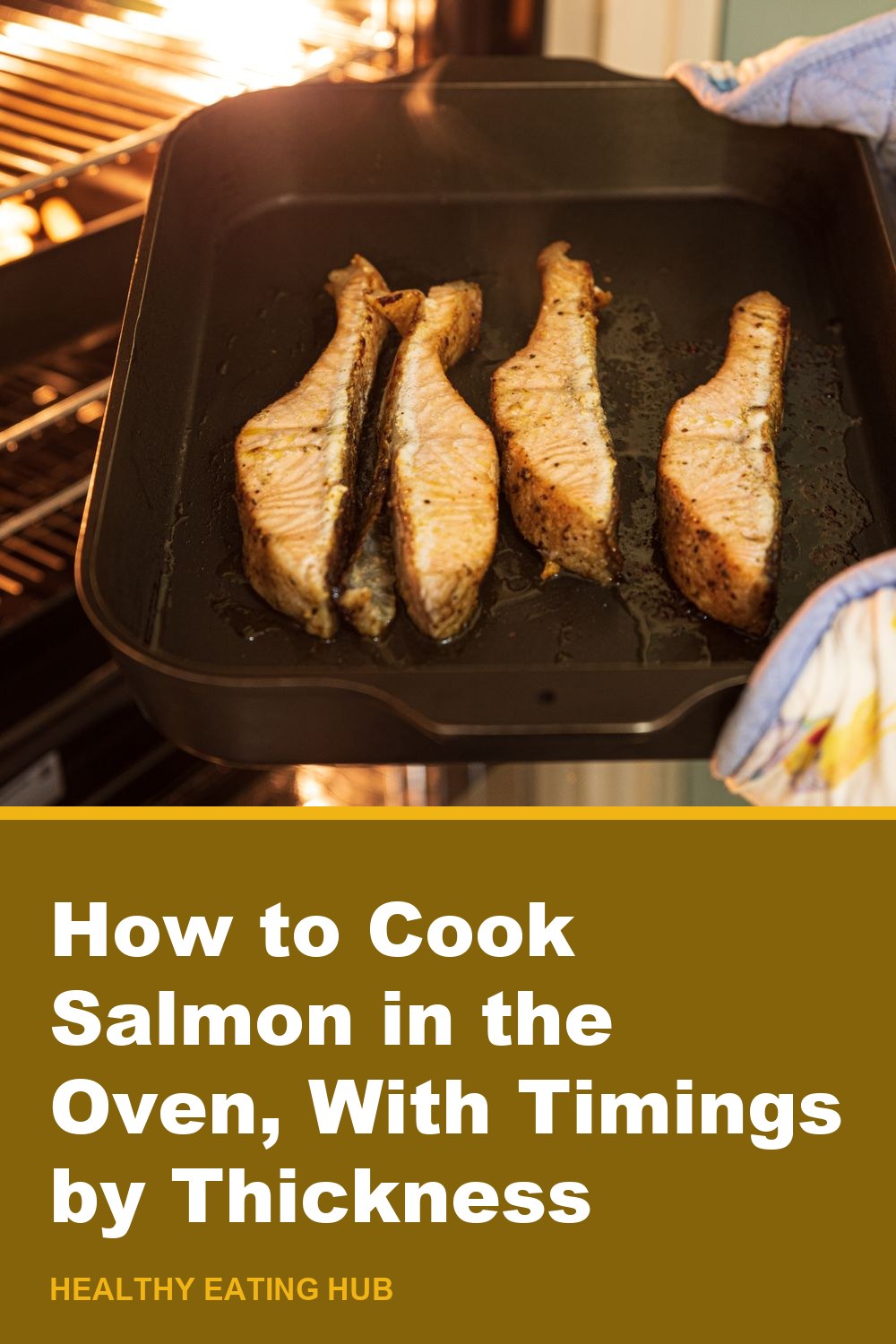

You've got a pack of salmon fillets, a hungry household and maybe 25 minutes. You don't want dry, chalky fish, and you don't want a raw middle either. The good news is that the oven is the most forgiving way to get it right.
Here's the short answer. Heat the oven to 200°C (180°C fan, 400°F). Measure the fillet at its thickest point. Roast for roughly 4 to 5 minutes per centimetre of thickness, so a standard 2.5 cm fillet takes about 12 to 15 minutes. It's done when the flesh is opaque, flakes easily and reads 63°C (145°F) in the thickest part on a food thermometer. Everything below explains how to do that step by step, how to adjust for your fillets and what usually goes wrong.
1. Take the salmon out and measure it
Take the fillets out of the fridge about 10 minutes before cooking. Don't leave them out longer than that. A short rest takes the deepest chill off so the outside doesn't overcook while the middle catches up.
Now measure. Lay a ruler or tape measure upright against the thickest part of the fillet. Thickness matters far more than weight. A 150 g tail piece and a 150 g centre-cut piece can differ by 2 cm in height and by several minutes in the oven.
A typical portion is 120 to 150 g per person. If you're buying for the week, the NHS healthy eating guidance suggests at least two portions of fish a week, one of them oily, and salmon counts as oily fish.
2. Heat the oven to 200°C
Set the oven to 200°C, or 180°C if it's a fan oven. Give it 10 to 15 minutes to reach temperature. Putting fish into a cold oven throws every timing off.
While it heats, line a baking tray with baking paper or foil. This stops sticking and saves you scrubbing. If your fillets have skin, you'll place them skin-side down.
Ovens vary. Many run 10 to 20°C hotter or cooler than the dial says. If your oven is known to run hot, start checking 2 minutes early.
3. Season and oil the fillets
Pat the fillets dry with kitchen paper. Wet fish steams instead of roasting, and seasoning slides off.
Rub each fillet with about 1 teaspoon of oil. Season with a good pinch of salt and some black pepper. That's enough on its own. If you want more flavour, try one of these per two fillets:
- Lemon and garlic: 1 crushed garlic clove, zest of half a lemon, 1 tbsp chopped parsley.
- Soy and honey: 1 tbsp soy sauce, 1 tsp honey, 1 tsp grated ginger. Brush on halfway through so the sugar doesn't burn.
- Mustard crust: 1 tsp wholegrain mustard spread on top, then 1 tbsp breadcrumbs.
Space the fillets at least 3 cm apart on the tray. Crowded fish cooks unevenly.
4. Roast using the thickness chart
Follow this core sequence:
- Place the tray on the middle shelf of the hot oven.
- Set a timer for the lower end of the time in the chart below.
- When the timer goes, check the thickest fillet first (see step 5).
- If it's not done, return it for 2 minutes and check again.
- Take it out as soon as it reaches 63°C or flakes cleanly.
Use these times at 200°C (180°C fan) for fillets that have rested 10 minutes out of the fridge. Treat them as a starting point, not a promise.
| Thickness at thickest point | Typical cut | Time from chilled | Time from frozen |
|---|---|---|---|
| 1.5 cm | Tail piece | 7 to 9 minutes | 12 to 15 minutes |
| 2.5 cm | Standard supermarket fillet | 12 to 15 minutes | 18 to 22 minutes |
| 3.5 cm | Thick centre-cut | 15 to 18 minutes | 22 to 27 minutes |
| 4.5 cm or more | Loin or very thick portion | 18 to 22 minutes | Thaw first for even cooking |
For frozen fillets, rinse off any ice glaze, pat dry, oil and season, then roast. Frozen times vary a lot with fillet shape, so always check with a thermometer. For a whole side of salmon, go by the thickest part and expect 20 to 25 minutes for a side about 3 cm thick.
5. Check it's cooked
Don't rely on the clock alone. Use at least one of these signs, ideally two.
The thermometer check
Push a probe thermometer into the thickest part of the fillet, from the side, so the tip sits in the centre. Food-safety guidance, including from the Academy of Nutrition and Dietetics, puts fish at a safe minimum internal temperature of 63°C (145°F). A basic digital probe is cheap and takes the guessing out of every fish dinner.
The visual checks
- Colour: the flesh turns from glossy, translucent orange to opaque pale pink all the way through.
- Flaking: press the top gently with a fork. Cooked salmon separates easily along its natural lines.
- White beads: small spots of white protein appear on the surface. A few is normal. Lots of it oozing out means you've gone too far.
The Food Standards Agency advises cooking fish until it's steaming hot and the flesh is opaque and flakes easily. If you're pregnant, cooking for young children, older people or anyone with a weakened immune system, cook it fully and ask a doctor or midwife if you're unsure what's safe.
6. Rest, serve or store
Let the salmon sit on the tray for 2 to 3 minutes. The heat evens out and the fillet holds together better when you lift it. If the skin sticks, slide a thin spatula between flesh and skin and leave the skin behind.
For meal prep, roast 4 fillets at once. Cool leftovers quickly, cover them and get them into the fridge within 2 hours. Eat them within 2 days. Cold flaked salmon works in salads, grain bowls and wraps. If you reheat it, make sure it's steaming hot all the way through, and only reheat it once.
7. Or pan-sear it instead
No oven, or only one or two fillets? A frying pan is faster and gives you crisp skin.
- Pat the fillets very dry and season with salt.
- Heat 1 tbsp oil in a non-stick or heavy pan over medium-high heat for about 2 minutes.
- Lay the fillets in skin-side down, away from you. Press each one flat with a spatula for 10 seconds.
- Cook without moving for 4 to 5 minutes for a 2.5 cm fillet, until the opaque colour creeps about two-thirds of the way up the side.
- Flip and cook for 1 to 3 minutes more, then check for 63°C or clean flaking.
For thick fillets over 3.5 cm, sear the skin side for 4 minutes, then move the pan into a 200°C oven for 5 to 7 minutes. An air fryer works on the same thickness logic: around 180 to 200°C for 8 to 12 minutes for a 2.5 cm fillet, depending on the model, so check early.
Common mistakes
1. Timing by weight instead of thickness
Two fillets of the same weight can need very different times. A thin tail overcooks in the time a thick loin needs. Measure the thickest point and, if pieces differ, pull the thin ones out first.
2. Skipping the drying step
Fillets straight from the pack are often wet. That moisture steams the surface, so skin goes soft and seasoning washes off. Ten seconds with kitchen paper fixes it.
3. Waiting for it to look dry
Many people keep salmon in until it looks completely firm on top. By then the inside is often past done and lots of white protein has leaked out. Check at the lower time in the chart and take it out as soon as it hits 63°C.
This article is general cooking and food-safety information, not medical or nutrition advice. If you have a health condition, allergies or special dietary needs, ask your doctor or a registered dietitian.
Watch or listen to this episode

I'm an Italian creator who builds apps, games and websites. I run Healthy Eating Hub with the help of AI tools: every article starts from the sources linked above, and I check what goes out. I'm not a doctor, a lawyer or a financial adviser. Spotted a mistake or have an idea? Write to me.
Instagram @spartaco_94_My websiteWrite to meAbout this blog