Healthy Eating Hub

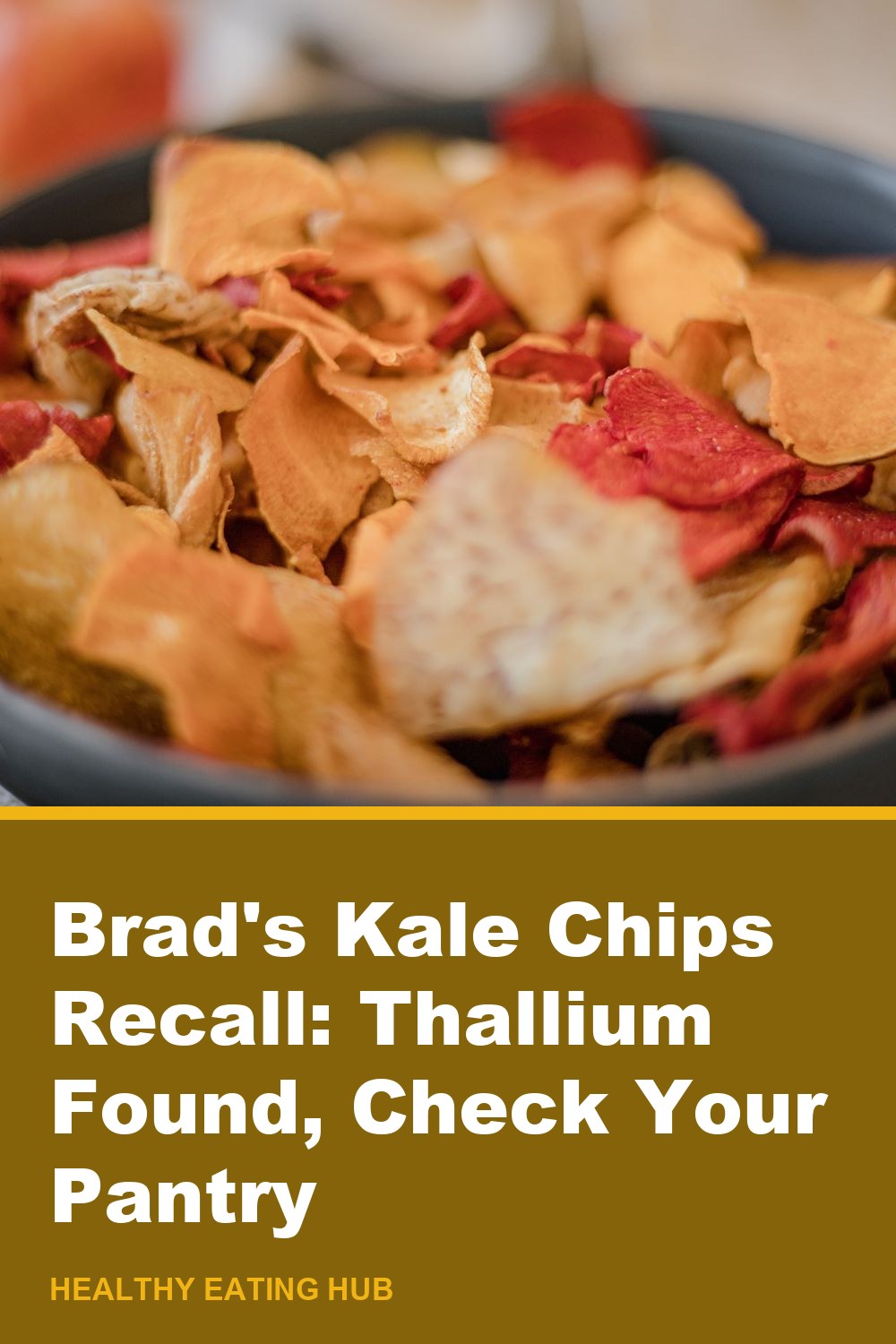

If a bag of Brad's Plant Based Crunchy Kale or Brad's Veggie Chips Kale is sitting in your pantry, lunchbox or desk drawer, stop serving it. Snack Right Super Foods Inc., doing business as Brad's Raw Chips, is recalling these products because they may contain thallium, a naturally occurring metal. Roughly 25,000 bags are estimated to be in commerce, so this is worth a few minutes of checking, especially if you buy kale chips as a school or work snack.
What was recalled and why
According to Food Safety News, the recall covers specific flavors and sizes of Brad's Crunchy Kale and Brad's Veggie Chips Kale. The bags were distributed nationwide through KeHE Distributors and United Natural Foods Inc. (UNFI), and the company also sold directly to five individual consumers. Distribution took place between October 2025 and December 2025.
The recall followed testing by public health authorities. In May 2026, the California Department of Public Health advised people not to eat certain Brad's Plant Based products. The department had looked into an inquiry from one person with elevated thallium levels, collected samples at retail stores in the Sacramento area, and found elevated thallium in multiple varieties. The company then started the recall after the U.S. Food and Drug Administration told it that thallium had turned up in tested products.
Which bags to look for
Not every Brad's bag is on the list. Match the product name, bag size, UPC, lot number and Best By date. The details below come from the recall notice as reported by Food Safety News.
| Product | Bag size | UPC | Lot number(s) and Best By date |
|---|---|---|---|
| Brad's Crunchy Kale, Original | 2 oz (57 g) | 813104021679 | Lots 33525-1, 33525-2, 33525-3 (Best By Feb. 1, 2027); Lot 34525-1 (Feb. 11, 2027); Lot 35125-2 (Feb. 17, 2027) |
| Brad's Crunchy Kale, Cheeze It Up | 2 oz (57 g) | 813104021877 | Lot 35025-3 (Best By Feb. 16, 2027) |
| Brad's Crunchy Kale, Radical Ranch | 2 oz (57 g) | 813104020726 | Lot 29425-1 (Best By Dec. 21, 2026) |
| Brad's Veggie Chips Kale | 3 oz (85 g) | 854615002054 | Lot 33225-3 (Jan. 28, 2027); Lot 33325-2 (Jan. 29, 2027); Lot 33425-1 (Jan. 30, 2027); Lot 33525-1 (Feb. 1, 2027) |
What thallium is, and why kale can carry it
Thallium is found naturally in soil and in sulfur-based minerals. Plants can take it up from the ground. Food Safety News reports that this is particularly true of the Brassicaceae family, which includes kale, cabbage and radish. The recall notice lists gastroenteritis, damage to peripheral nerves and hair loss among the serious health effects that acute or chronic exposure can cause.
The company's statement, as reported, says the manufacturing process did not introduce the contaminant. Kale is a brassica crop known to accumulate certain elements from soil. The key detail for snack buyers is the drying step. Dehydration removes about 85 to 90 percent of the product's water, which concentrates elements already present in the fresh kale.
What this means for snacks made from leafy greens
A crunchy chip is a lot of leaves squeezed into a small bag. When water leaves, whatever was in the leaf stays behind, so a trace in fresh kale can become a bigger share of a dried snack's weight. That is the mechanism the recall describes, and it is a useful thing to understand about any dried vegetable product.
It does not mean all kale, or all kale chips, are contaminated. This recall names particular products and lots, and the testing that triggered it was done on Brad's Plant Based products. Still, it is a good reminder that a snack's "vegetable" label does not tell you where the plants were grown or what the soil contained. Buying from brands that respond quickly to recalls, and keeping an eye on recall news, is a sensible habit for families who eat a lot of packaged produce snacks.
What to do now
Work through this short routine today:
- Search every snack spot. Check the pantry, school and work bags, the car, and any desk drawer or gym bag where a kale chip bag might be sitting.
- Compare the bag to the table. Look at the flavor, the size (2 oz or 3 oz), the UPC, the lot number and the Best By date. If your bag matches a row, treat it as recalled.
- Stop eating it and discard it. The notice tells consumers to stop consuming the products immediately and throw them away.
- Do not take it back to the store. Refunds are not being offered, and the product should not be returned to the place of purchase.
- Tell others. If you shared bags with relatives, neighbors, a carpool or a classroom, pass the lot details along.
- Handle questions about health with a professional. If someone in your household ate these chips and you are worried, or has symptoms that concern you, talk to a doctor. A dietitian can help if you want to rethink snacks more generally.
If your bag does not match any lot in the table, it is not part of this recall notice. You may still want to watch for updates from the company, the FDA or the California Department of Public Health.
Smart swaps while you wait for answers
You do not have to give up crunchy snacks. Whole fruit, plain popcorn, nuts, seeds, or sliced raw vegetables with hummus all work in lunchboxes. If you enjoy the savory-crunch feel of kale chips, you could also make your own at home. Keep in mind that baking removes water from fresh leaves in the same way, and that the recall notice points to the kale itself as the source of the thallium. Variety across the week is a good principle in any case, since it avoids relying heavily on any one crop.
FAQ
Which Brad's kale chips are being recalled for thallium?
The recall covers Brad's Crunchy Kale in Original, Cheeze It Up and Radical Ranch (all 2 oz bags) and Brad's Veggie Chips Kale (3 oz bag), but only the specific lot numbers and Best By dates shown in the table above. Best By dates range from December 21, 2026 to February 17, 2027.
Can I get a refund for recalled Brad's kale chips?
According to the recall notice reported by Food Safety News, refunds are not being offered. Consumers are told to discard the product and not to return it to the store where they bought it.
Why does drying kale matter for thallium?
Kale and other brassicas can take up certain elements from soil. Dehydration removes about 85 to 90 percent of the product's water, which concentrates elements already in the fresh kale. That is why a dried snack can contain more of a substance, by weight, than the fresh leaves it was made from.
Sources
Photo: RDNE Stock project / Pexels

I'm an Italian creator who builds apps, games and websites. I run Healthy Eating Hub with the help of AI tools: every article starts from the sources linked above, and I check what goes out. I'm not a doctor, a lawyer or a financial adviser. Spotted a mistake or have an idea? Write to me.
Instagram @spartaco_94_My websiteWrite to meAbout this blog